

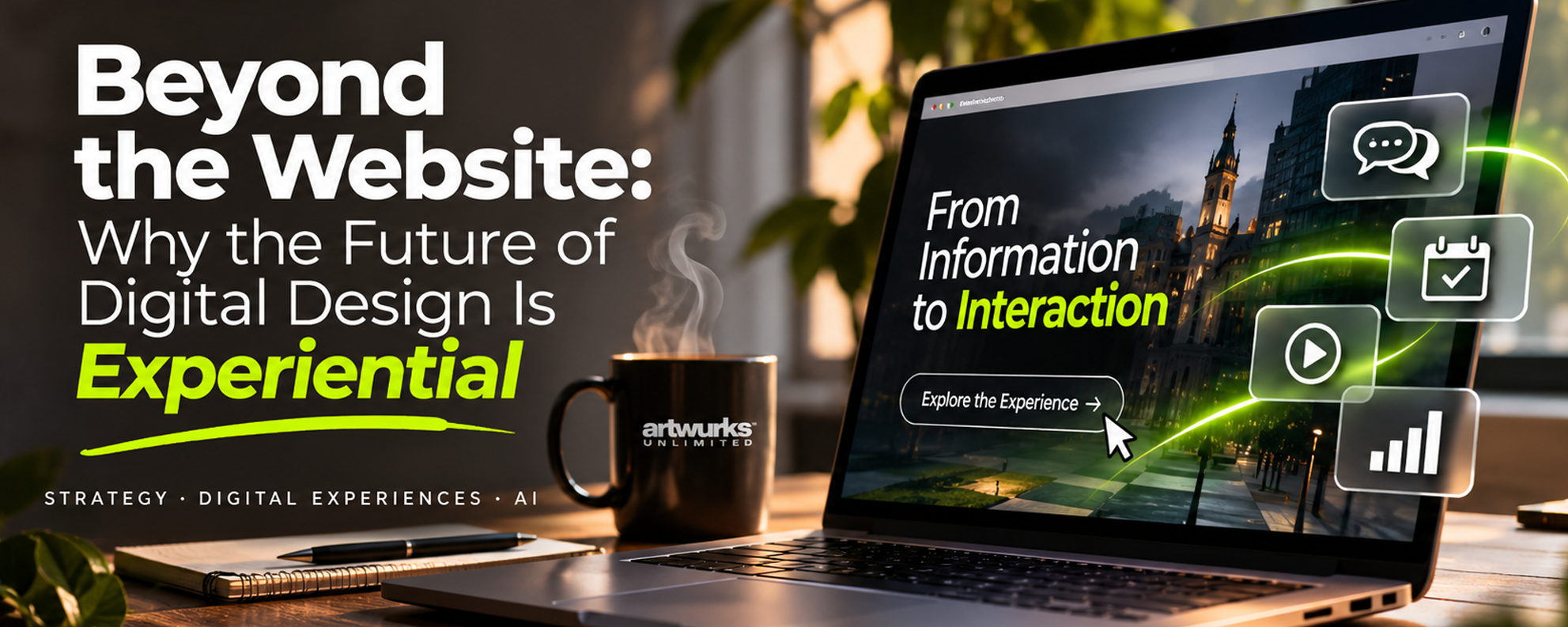
For years, businesses have approached their websites as digital destinations: places where visitors arrive, find information, browse services, and hopefully make contact.
But the expectations of digital audiences are changing. People increasingly expect more than information. They want experiences that respond to their needs, answer their questions, help them make decisions, and make interacting with a business feel effortless.
The next evolution of digital design isn't simply about creating better-looking websites. It's about creating more meaningful interactions.
From Digital Brochures to Living Experiences
A beautifully designed website still matters. Strong visual communication builds credibility, establishes identity, and helps people understand what makes an organization distinctive. But aesthetics alone don't create engagement.
Consider two websites presenting the same service. One provides paragraphs of information and a contact form. The other helps visitors explore their options, answers relevant questions, provides guidance, and makes the next step clear.
Both communicate information. Only one actively participates in the visitor's experience. This is the difference between designing a digital presence and designing a digital relationship.
The New Role of Interactive Technology
Interactive experiences can take many forms. A neighborhood organization might use an interactive guide to help residents understand local initiatives and discover ways to participate. An educational platform might make learning more approachable through responsive activities and personalized guidance. A service business might use an intelligent assistant to help prospective clients find answers and connect with the right person.
The technology varies. The underlying design principle remains consistent: Start with the human need, then determine which technology genuinely improves the experience.
Not every website needs artificial intelligence. Not every interaction needs animation. And not every business problem requires another application. The challenge is knowing when additional functionality creates real value.
Artificial Intelligence Should Support the Relationship
AI has expanded what's possible within digital experiences, but its value depends on how thoughtfully it's implemented. An AI assistant can help a business respond to inquiries, guide visitors through available services, and make information easier to access.
However, automation shouldn't become a barrier between people and the organizations they want to reach. The best implementations recognize their limitations, preserve human oversight, and make it easy to reach a real person when the situation requires one.
Technology should strengthen trust, not replace it. At Artwurks Unlimited, this philosophy informs our exploration of AI-assisted business systems and more responsive digital experiences.
Design for Participation, Not Just Attention
Attention is valuable, but participation creates a deeper connection. When people can explore information, interact with a story, discover resources, or receive useful guidance, they become participants rather than passive viewers.
That opens opportunities for businesses and community organizations to communicate in ways traditional websites cannot always accomplish.
The goal isn't to make every digital experience elaborate. Sometimes a thoughtfully designed interaction is simple: a helpful question, a clear choice, an intuitive demonstration, or a timely response.
Meaningful interaction doesn't require complexity. It requires intention.
A Different Way to Think About Digital Investment
Businesses often measure a website project by its launch date. The design is approved. The content is published. The website goes live. Project complete.
But launching a website is only the beginning of its relationship with the people it serves. What happens after someone arrives? Can they understand the business? Can they find what they need? Can they take meaningful action? Does the experience make them more confident about what comes next?
Those questions deserve as much attention as the initial design.
The Future Is Human-Centered
As digital tools become more capable, the temptation will be to add features simply because they're available. But successful digital experiences won't necessarily be the ones with the most technology. They'll be the ones where technology feels purposeful, accessible, and genuinely useful.
That requires a combination of thoughtful strategy, compelling design, functional technology, and an understanding of the people on the other side of the screen.
At Artwurks Unlimited, we see this as a natural evolution of creative work: moving beyond what people see toward what they can experience.
Because the future of digital design isn't about replacing the human element. It's about making more room for it.
Strategy first. Relationships always. Pixels when they add value.
Artwurks Unlimited — Identify. Design. Build. Improve.
